YveChat Opens Developer Preview of Its Sovereign AI Workspace
YveChat has opened the developer preview of its sovereign AI workspace, a hosted interface paired to AI models running on your own machine. Local models, conversations, and compute stay on hardware you control.
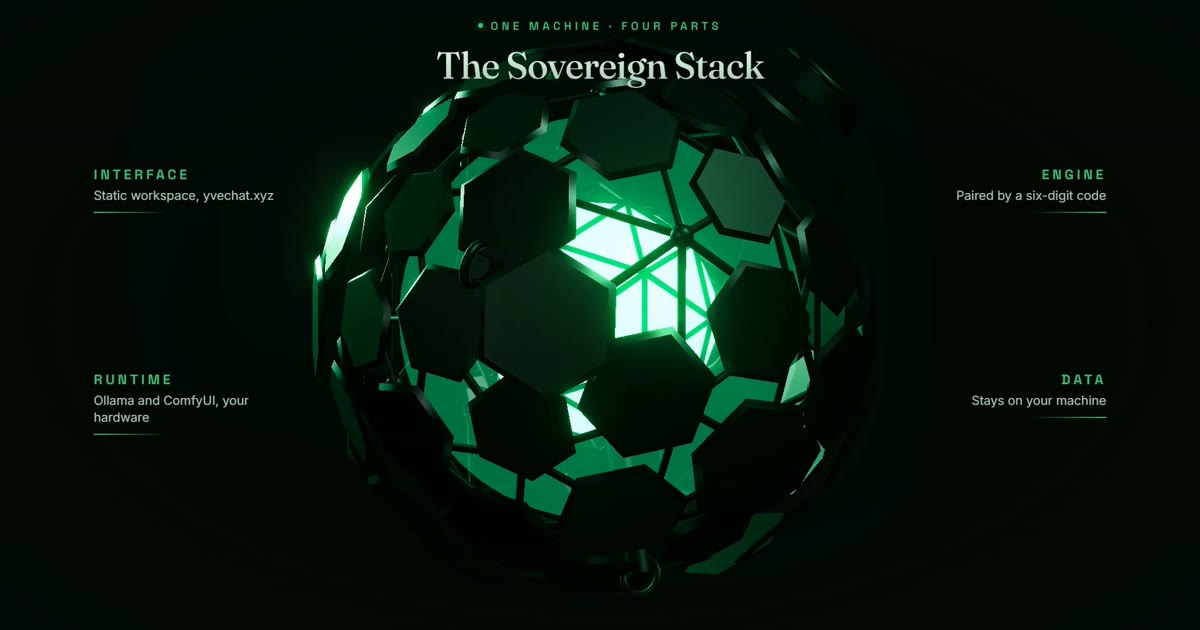
YveChat has opened the developer preview of its sovereign AI workspace, bringing its core local architecture into a working product environment where models, conversations, and compute can remain on hardware controlled by the user.
The developer preview connects the hosted YveChat workspace with YveChat Engine, a local process running on the user's computer. The workspace provides the interface for conversations, model selection, tools, and citations. The Engine handles local runtime discovery, model requests, conversation storage, and other operations that require access to the user's machine.
When a local model is selected, inference runs through the user's own hardware. Conversations are persisted by the Engine to a local SQLite database, keeping the working history on the user's disk.
The release marks the latest step in YveChat's broader goal of applying self-custody principles to AI.
From browser to local machine
At the center of the architecture is YveChat Engine.
A hosted browser interface faces practical restrictions when communicating directly with software running on a local computer. Browser local-network policies, cross-origin restrictions, and runtime configurations can create inconsistent access to services such as Ollama. YveChat Engine provides the local boundary between the workspace and those resources.
Users pair the workspace with their Engine through a six-digit code approved on their own machine. Pairing is origin-bound and includes expiry and revocation controls. Once connected, the Engine can discover supported runtimes and expose available models to the workspace.
The resulting flow keeps the major components clearly separated:
- Workspace: threads, model selection, tool activity, and citations
- YveChat Engine: runtime discovery, routing, secrets, tool execution, and local persistence
- Runtimes: Ollama and compatible model endpoints
- Storage: conversations and settings managed locally through SQLite
For local Ollama conversations, prompts are routed from the workspace through the Engine to the model running on the user's hardware. Responses stream back through the same path, and the completed thread is persisted locally.
Local AI as a working path
Ollama-served language models are available in the developer preview, allowing supported open-weight models to run directly on user hardware without provider credentials.
Dynamic model discovery allows the Engine to identify models available through the local runtime. Validated Ollama model downloads are also supported, giving users a more accessible route to expanding the models available inside their workspace.
Local image generation extends the same approach into Image Studio through ComfyUI.
Other available capabilities include web search with citations through Ollama Web Search and SearXNG, local conversation storage, local accounts, optional wallet authentication, browser pairing, configured origin controls, and capability filters.
The architecture is designed so that sovereignty properties can be observed through the system itself. Local inference can be verified through network activity, conversation storage can be inspected on disk, and the Engine creates a visible boundary for operations involving local resources.
Identity can stay with the user
The developer preview supports local accounts alongside optional wallet authentication.
Wallet authentication uses a signature as identity, giving users a path to access based on credentials they control. Local accounts remain available for users who prefer a conventional login within their own environment, with passwords protected using scrypt hashing and a minimum-length requirement.
Together, these options form part of YveChat's broader custody model across compute, data, access, and identity.
Available today and still being built
YveChat is releasing the workspace as a developer preview while development continues across the wider architecture.
Available
- Local language models served through Ollama
- Dynamic model discovery
- Validated Ollama model downloads
- ComfyUI local image generation
- Web search with citations
- Local SQLite conversation storage
- Local accounts
- Optional wallet authentication
- Six-digit browser pairing
- Origin policy and capability filters
Experimental
- OpenAI-compatible endpoints using a manually configured base URL
- vLLM through the OpenAI-compatible adapter
- Page reading and extraction tools
- PDF reading
Planned
- Full hosted model-provider credential management
- MCP connections with per-tool permissions
- Sandboxed code execution
- Local file and document retrieval
- Additional utility and data adapters
- User-configurable external storage
- Public signed and notarized installers with automatic updates
This distinction will remain part of how YveChat reports development. Features will continue to be identified according to their actual stage as available, experimental, or planned.
The developer preview moves forward
The current release represents the working foundation of the YveChat architecture while public installers and broader onboarding continue toward release.
The Custody era is complete, and YveChat is currently in the Engine era. The unsigned developer-preview archive is available today, while signed production installers remain planned. Page and PDF reading are Experimental through the gateway layer. Broader Gateway-era capabilities remain ahead, including permission-controlled actions, MCP connections, sandboxed execution, and broader credential management.
Each stage follows the same principle established by the developer preview: control should remain observable and understandable to the person using the system.
YveChat's direction can be stated simply.
Your models. Your machine. Your workspace.