Local AI Needs Better Infrastructure
CTO Alvis Sim on why local AI needs better infrastructure, why YveChat Engine exists, and what has to change before local intelligence feels effortless.
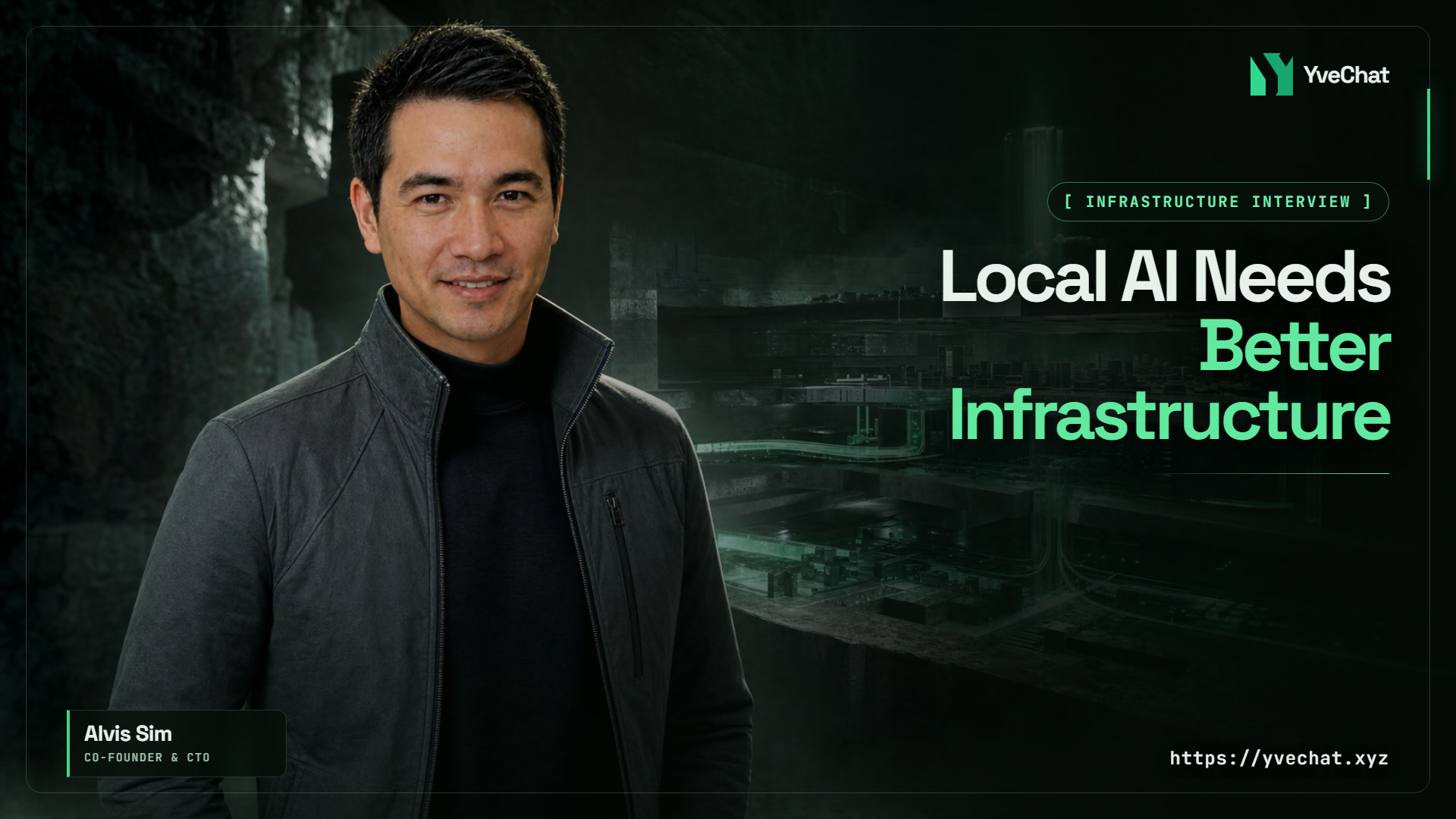
Local AI has crossed an important threshold. Open weight models are increasingly capable, consumer hardware can run serious workloads, and runtimes such as Ollama have made local inference dramatically more accessible.
For YveChat Co-Founder and CTO Alvis Sim, the next challenge sits around the model itself. The infrastructure surrounding local AI still asks users to think about runtimes, model discovery, hardware, context limits, endpoints, storage, and browser connectivity before they can focus on the work they actually want to do.
Alvis leads the engineering behind YveChat, with much of his work centered on local model infrastructure, self-hosted data, provider-neutral architecture, and agent tooling. We sat down with him to discuss where local AI stands today, why YveChat Engine exists, and what needs to happen before locally controlled intelligence becomes a natural part of everyday computing.
The model is only one part of local AI
Q: Local models have improved enormously. Why do you say local AI still needs better infrastructure?
Alvis: Because model capability solves one part of the experience.
You can download an excellent model today, and then immediately encounter a series of infrastructure questions. Which runtime serves it? Does your hardware have enough memory? What context length are you actually running? How does an application discover the model? Where are conversations stored? How does a browser communicate with the runtime securely?
Ollama has done a lot to simplify one important layer. You can install it, pull a model and start serving inference very quickly. That's a major improvement. The next opportunity is making everything around that model feel equally coherent.
Q: What does a better experience look like to you?
Alvis: Ideally, the infrastructure becomes quiet.
The user opens a workspace. Their available models appear. They select one. The system understands where that model runs. Their conversation goes to the right place. Their history persists where they expect it to persist. When something requires permission or leaves the local environment, the system makes that visible.
There is still a lot happening underneath, but the user doesn't have to manually reconstruct the architecture every time they want to use local intelligence.
Why YveChat Engine exists
Q: YveChat uses a hosted workspace alongside a local component called YveChat Engine. Why did you choose that architecture?
Alvis: We wanted the convenience of a web workspace while keeping the important local responsibilities on the user's machine.
Browsers have deliberate security boundaries around local resources. Ollama has origin policies. Chrome has local network access controls. Different browsers can behave differently around loopback connections. Then you have credentials, conversation storage, runtime discovery and eventually tools. Those responsibilities need a reliable local boundary. That's what the Engine gives us.
The workspace handles the interface. The Engine runs on the user's machine and handles runtime discovery, routing, local persistence, secrets, and operations that require access to local resources.
Q: What happens when somebody sends a prompt to a local Ollama model through YveChat?
Alvis: The workspace sends the request through the paired Engine. The Engine routes it to the Ollama runtime on the user's hardware. The model performs inference locally, tokens stream back through the Engine, and the conversation can be persisted to the local SQLite database managed by the Engine.
For that local inference path, the user's machine is doing the computation. That boundary is very important to us because it gives the user something concrete they can understand and inspect.
Self hosted data changes the architecture
Q: Conversation storage sounds less exciting than models. Why does YveChat place so much emphasis on it?
Alvis: Because the conversation history becomes more important over time.
A model can be replaced tomorrow. Your accumulated context might represent months or years of research, decisions, drafts, and project knowledge. That changes how I think about the architecture. The database isn't an incidental component. It is part of the user's intelligence infrastructure.
Today, YveChat Engine manages conversation persistence through SQLite on the user's own disk. User-configurable external storage is planned as we expand that layer.
Q: Does keeping data locally create additional responsibility for the user?
Alvis: Yes. Control comes with operational responsibility.
If your data lives on infrastructure you manage, backups matter. Device security matters. Storage availability matters. Organizations operating infrastructure for other people can also take on regulatory responsibilities. We document those realities because self hosting should be understood clearly. Better infrastructure should make those responsibilities manageable and visible.
Provider neutrality starts below the interface
Q: YveChat talks frequently about provider neutrality. What does that mean from an engineering perspective?
Alvis: It means the architecture has to expect models and providers to change.
Ollama-served models are our available local path today. We also have experimental support for OpenAI-compatible endpoints and vLLM through that adapter. Full hosted provider credential management is planned. The goal is a normalized layer where different runtimes can participate in the same workspace.
Users should be able to choose a model because it fits the task. The workspace, conversation history, and surrounding infrastructure should remain consistent as that choice changes.
Q: Why do you think that matters more now?
Alvis: Look at how quickly the model landscape moves.
Open weight models improve. New architectures appear. Hardware changes. Providers release new capabilities. A workspace tightly coupled to one intelligence source becomes less flexible every time the market moves.
I think model choice will increasingly become a normal part of using AI. Sometimes the right answer will be a local model. Sometimes it will be a model running on dedicated GPU infrastructure. Sometimes it will be a hosted frontier provider. Infrastructure should make those choices easier to manage.
Local AI still has physical limits
Q: There is growing excitement around running increasingly powerful models locally. What limitations do you think users should understand?
Alvis: Hardware still matters enormously.
Model size, quantization, available memory, context length, and parallelism all affect what you can realistically run. Ollama defaults to a 4096 token context, for example, and increasing context has memory consequences. GPU support also depends on hardware and drivers.
There is also a capability question. Frontier hosted models remain stronger for many workloads. Local models give you a different set of advantages, particularly around control, privacy, and direct ownership of the compute environment. The useful question is what model fits the workload and what infrastructure the user wants around it.
Q: Is that why YveChat supports multiple model paths?
Alvis: Exactly.
Local AI is a first class path for us, and provider neutrality gives users room to make different choices when the task requires them. The architecture should support that decision instead of making the decision for them.
Agents make infrastructure more important
Q: You also spend a lot of time thinking about agent tooling. How does that connect to local AI infrastructure?
Alvis: Agents expand the infrastructure problem considerably.
A chat model receives a prompt and generates a response. An agent can potentially read files, search the web, execute code, access credentials, call services or change something outside the workspace. Now you have to think about permissions, authentication, tool boundaries and what happens when external systems become involved. This is where infrastructure becomes part of user control.
Q: What does that mean for YveChat's Gateway work?
Alvis: We are designing around explicit boundaries.
Reading and retrieval should disclose their activity. State changing actions such as sending, purchasing, writing or authenticating should require explicit confirmation. MCP connections with per-tool permissions are planned. Sandboxed code execution is planned as well.
MCP is powerful because it creates a common way for models to interact with tools. That power also means hosts have to treat permissions seriously. Local MCP servers can execute code, tool metadata can be untrusted, and reading tools introduce their own security considerations. The usability challenge is making those controls understandable without turning every action into friction.
What local AI needs next
Q: If you could change one thing about the local AI ecosystem over the next few years, what would it be?
Alvis: I want local AI to become something people use without thinking of themselves as local AI users.
They should be able to choose intelligence running on hardware they control because it makes sense for the task, then get on with their work. That requires better model discovery, better hardware awareness, clearer storage, consistent interfaces, stronger permission systems, and easier connections between applications and local runtimes.
The models are moving quickly. The infrastructure around them has to catch up.
Q: And where does YveChat fit into that future?
Alvis: We are building the workspace around the assumption that control over intelligence will matter more over time.
Models are one layer. Conversations, compute, credentials, identity, tools, and permissions form the infrastructure around them. The next phase of AI will be shaped by who controls that infrastructure. YveChat is our answer.
Your machine becomes part of the AI stack
The direction Alvis describes extends beyond making local models easier to run.
As AI systems accumulate memory, connect to tools, and gain greater authority, the infrastructure surrounding the model becomes increasingly consequential. Storage determines where intelligence accumulates. Credentials determine what services it can reach. Permissions determine what it can do. Compute determines where intelligence runs.
YveChat Engine brings those layers back to a boundary the user can see and control. For Alvis, that is where the future of local AI becomes considerably more interesting.
Your models. Your machine. Your workspace.