The Conversations Behind YveChat
YveChat's two co-founders on where sovereignty starts for each of them, how philosophy meets engineering, and where they think AI is heading.
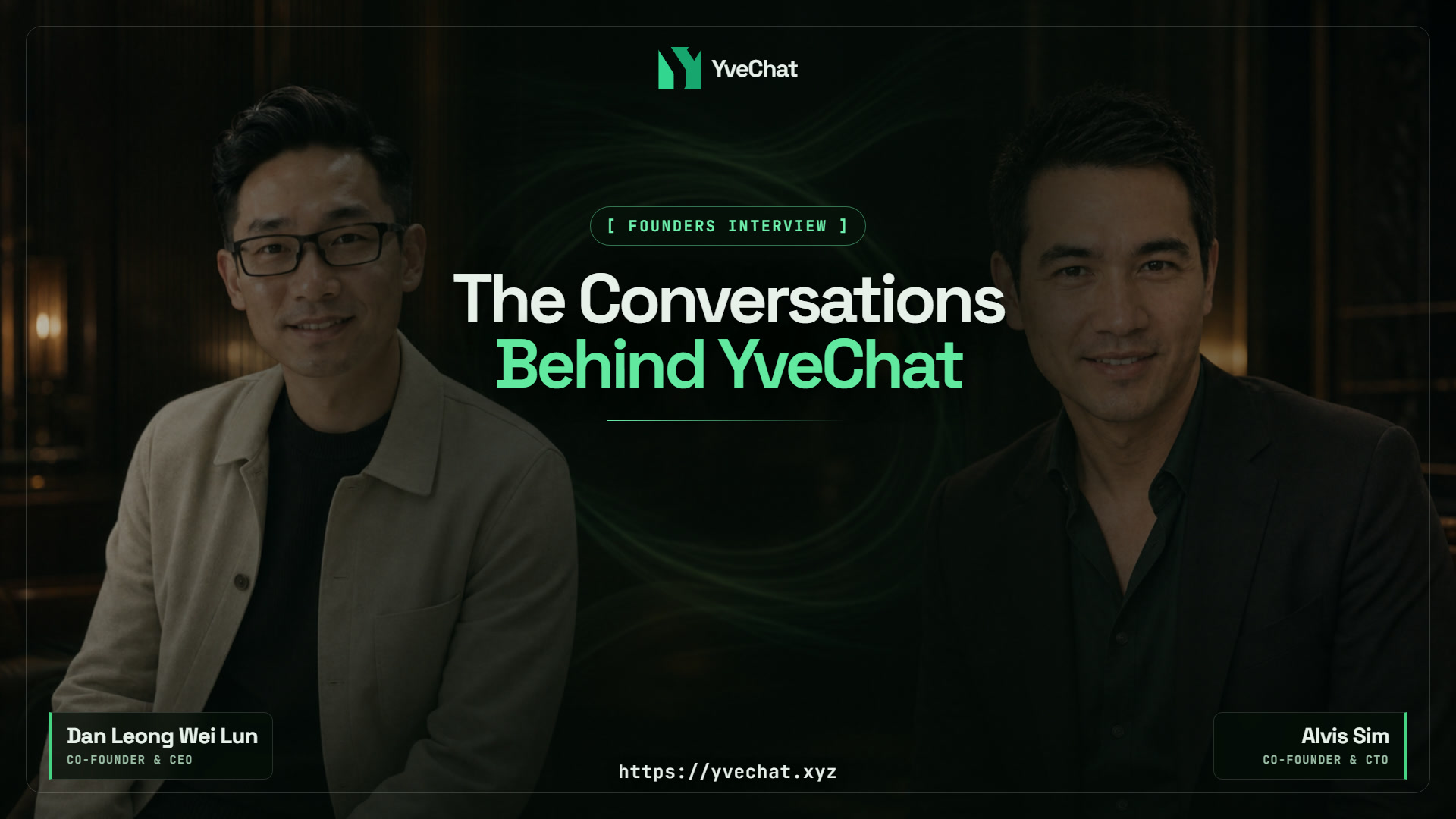
Building YveChat involves an ongoing conversation between two perspectives.
For Co-Founder and CEO Dan Leong, the starting point is ownership. As AI becomes a place where people research, create, make decisions, and develop ideas, he believes the resulting record of intelligence should remain in the user's custody. For Co-Founder and CTO Alvis Sim, that principle immediately becomes an infrastructure question. Where does the model run? Where are conversations stored? Who holds the credentials? What happens when an agent is given permission to act?
Head of Marketing Clara recently sat down with both cofounders for a more relaxed conversation about those questions, how they work together, what they are building now, and where they believe AI is heading.
Two perspectives on the same problem
Clara: You both talk about sovereignty constantly, although you seem to approach it from very different directions. Where does each of you start?
Dan: I usually start with what AI is becoming for the person using it. A workspace can contain your research, unfinished ideas, decisions, questions and years of conversations. Over time, that becomes an incredibly detailed record of how you think. Once you see it that way, ownership becomes a very serious question.
Alvis: I immediately start thinking about where everything actually sits. Saying the user owns something has architectural consequences. Where is the database? Where does inference happen? Where are the credentials stored? What controls access? You have to be able to answer those questions technically.
Dan: That's probably a good description of how we work together. I'll ask what the relationship between the user and the product should be, and Alvis will start asking what has to exist underneath it for that relationship to be real.
Alvis: And sometimes I tell him the simple version is technically inconvenient.
Dan: Sometimes?
Alvis: Quite often.
When philosophy meets engineering
That exchange captures a recurring dynamic inside YveChat. The product is organized around four layers of user control: compute, data, access, and identity. Each principle creates practical engineering decisions. YveChat Engine emerged from exactly that process.
Clara: Was the Engine always part of the idea?
Alvis: The need became obvious once we worked through how a hosted workspace should communicate reliably with local AI. Browsers have security boundaries. Ollama has origin policies. Local storage and credentials need somewhere appropriate to live. The Engine gives us a local process that can handle those responsibilities on the user's machine.
Dan: It also made the product philosophy much clearer. The website can be the workspace people interact with, while the things that matter stay behind a boundary they control.
Alvis: Exactly. The Engine discovers local runtimes, routes model requests, manages local persistence and handles operations that require access to the machine. When you use an Ollama model locally, your hardware performs the inference and the conversation can be persisted locally through the Engine.
Clara: So when Dan comes to you with a sovereignty principle, what happens next?
Alvis: Usually I get more work.
Dan: That's the arrangement.
Local AI has to become easier
Alvis has spent much of his time around local AI systems, model infrastructure, self-hosted data, and provider-neutral architecture. That experience has also made him conscious of the friction users still face.
Clara: Local AI has improved quickly. What still frustrates you about it?
Alvis: The individual pieces have become very capable. Ollama made serving models much easier. Open weight models keep improving. Hardware is improving. The experience around all of those pieces still has room to become much more coherent.
A user might need to understand runtimes, model sizes, context windows, hardware requirements, endpoints, and browser connectivity before they even reach the actual work they wanted the model to do.
Dan: That's important for us because sovereignty has to be practical. The value of ownership increases dramatically when ordinary users can exercise it without constantly thinking about infrastructure.
Alvis: Exactly. Good infrastructure eventually becomes quiet. You know you control it, you can inspect it when you want to, and most of the time you can focus on the work.
The model should be a choice
The conversation eventually turns to models, an area where both founders see rapid change ahead. YveChat currently supports Ollama-served local models, with OpenAI-compatible endpoints and vLLM support in experimental stages. Full hosted provider credential management is planned. The longer-term architecture treats these runtimes as peers within the workspace.
Clara: Do either of you think there will eventually be one dominant model that everyone uses?
Dan: I think people will become more selective. Different models already have different strengths, and that landscape moves quickly. The workspace should remain useful while those preferences change.
Alvis: From the engineering side, that's why provider normalization matters. The interface shouldn't have to be reinvented every time the intelligence underneath it changes. We want the model layer to remain flexible.
Dan: I want switching models to eventually feel ordinary. Your history remains yours. Your workspace remains yours. You choose the intelligence that makes sense for what you're doing.
Clara: And that connects to zero inference margin?
Dan: Completely. YveChat has no reason to steer someone toward a model because its inference is more profitable for us. The user chooses according to the task.
Alvis: Provider neutrality is much cleaner when the architecture and the economics point in the same direction.
What are you actually working on now?
The discussion shifts from philosophy to the current development cycle. YveChat has completed its Custody era and is currently in the Engine era. An unsigned developer-preview archive is available now, while signed production installers remain planned. Page and PDF reading are Experimental through the gateway layer, and broader Gateway-era capabilities remain ahead, including permission-controlled actions, MCP connections, sandboxed code execution, and broader credential management.
Clara: What occupies most of your attention right now?
Alvis: Boundaries and usability. We have the local architecture working, so the interesting problems increasingly involve what happens when the workspace reaches outward. Search is one example. MCP and agent tooling take that much further.
Every additional capability creates a permission question. What can the model read? What can it execute? What requires confirmation? What credentials does it have access to? Those decisions need to be explicit.
Dan: Agents make the sovereignty question much bigger. A conversation contains information. An agent can eventually hold authority. Once an AI can send something, buy something, authenticate somewhere or make a change on your behalf, control becomes very tangible.
Clara: So you see permissions as part of ownership?
Dan: Absolutely. If an AI acts for you, the authority it receives should ultimately come from you.
Where do you disagree?
Clara: You agree on the destination. Where do you disagree when building the product?
Dan: Usually on how much complexity a user should ever have to see.
Alvis: That's accurate.
Dan: I always want another layer simplified.
Alvis: And I want the product to remain technically honest about what is happening. Local infrastructure has realities. Hardware matters. Browsers have restrictions. Models have different requirements. Security boundaries matter.
Dan: Which is why the answer usually ends up somewhere useful. We simplify what can be simplified and explain what still matters.
Alvis: Sovereignty includes understanding the system you control. The experience can be simple while the boundaries remain visible.
That balance also informs YveChat's approach to limitations. Local model capability, context length, memory requirements, GPU support, browser behavior, and the risks surrounding external tools are documented as part of the product.
Where does AI go from here?
The final question moves beyond YveChat's current roadmap.
Clara: Imagine we have this conversation again several years from now. What do you think will have changed most?
Dan: AI will know considerably more about the people using it. The accumulated context could become extremely valuable. I think people will become much more conscious of where that intelligence lives and who controls it.
Alvis: I think agents will also make infrastructure much more important. Models are becoming one component inside larger systems. You have memory, tools, credentials, permissions, data and compute surrounding the model. Whoever controls that layer controls a significant part of the AI experience.
Dan: That's why our thesis is broader than any individual model. Models will improve. New providers will appear. Local hardware will become more capable. The important relationship is between a person and the intelligence they accumulate over time.
Alvis: And our job is to build the infrastructure that lets them hold it.
Built through the same conversation
Dan and Alvis arrive at YveChat's central question from different directions. One starts with the person and asks who should own the growing record of their intelligence. The other starts with the machine and asks what infrastructure makes that ownership technically real.
YveChat is being built in the space where those two conversations meet.
Your models. Your machine. Your workspace.