Own Your AI and What Comes Next
In a community AMA, Co-Founders Dan Leong and Alvis Sim cover self custody, YveChat Engine, what runs today, and the road through the Gateway era.
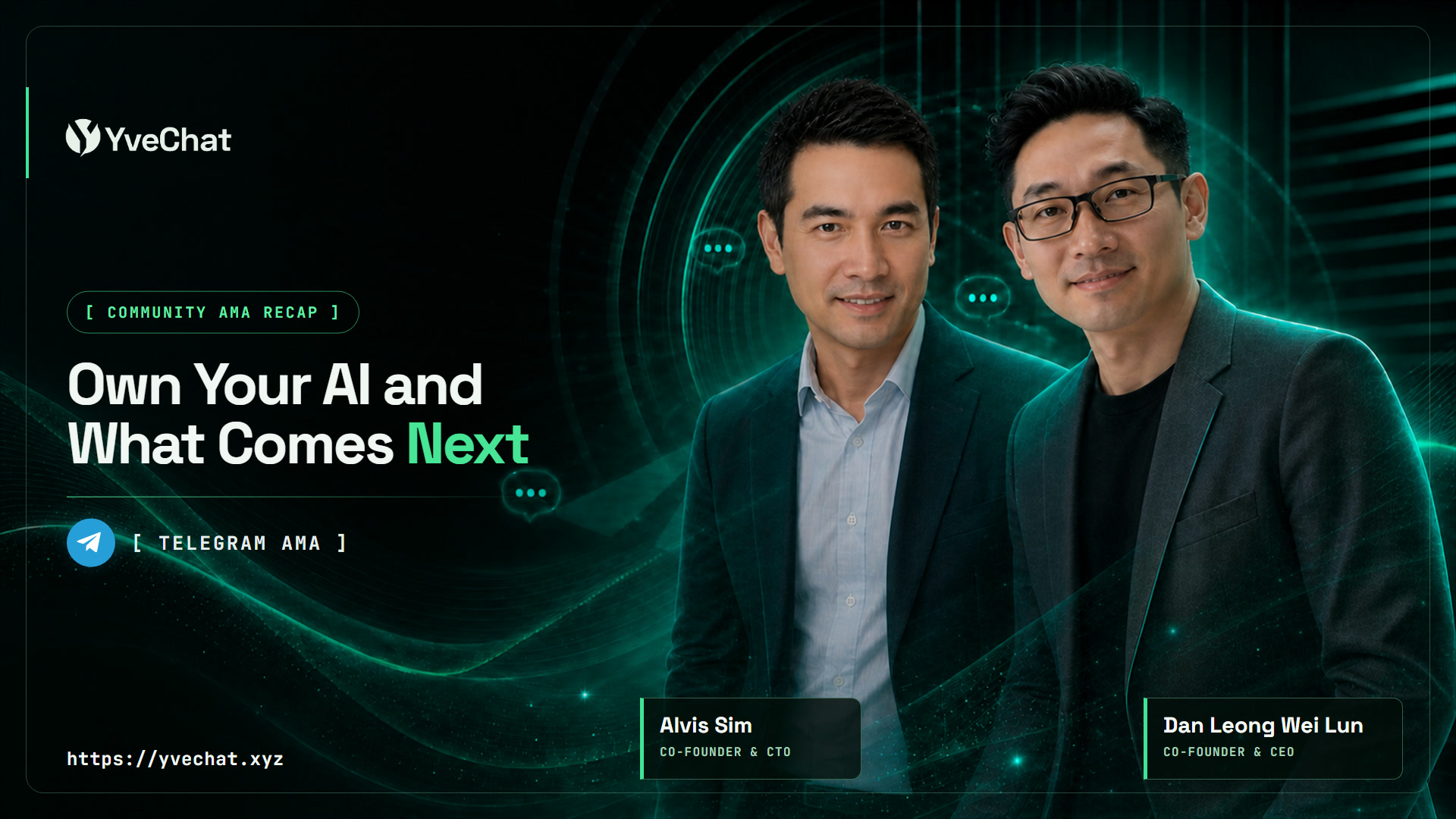
The latest YveChat Telegram AMA drew a strong response from the community, bringing Co-Founder and CEO Dan Leong and Co-Founder and CTO Alvis Sim together with Head of Marketing Clara for a wide-ranging discussion on self custody, local AI, YveChat Engine, current development, and the next stages of the Sovereign AI Workspace.
The session focused heavily on what users can already do, where development is heading, and why YveChat continues to place control of models, conversations, compute, credentials, and identity at the center of its architecture. Questions from the community also moved the discussion beyond product features into the larger issue both founders are working on from different directions: who controls the growing infrastructure around personal intelligence?
From owning assets to owning intelligence
Clara opened the discussion with YveChat's founding thesis and asked Dan why self custody matters in an AI workspace. Dan pointed to the amount of personal and professional context now accumulating through everyday AI use.
"AI is becoming a record of how we think," Dan said. "Research, decisions, unfinished ideas, questions and years of conversation can eventually become an incredibly detailed history of a person or a business. We believe that history should remain in their custody."
He described YveChat's approach as an extension of a principle already familiar across crypto. Ownership becomes meaningful when control sits directly with the individual. That philosophy shapes YveChat across four areas: compute, data, access, and identity.
Why does YveChat need an Engine?
One of the central technical discussions concerned YveChat Engine and why a local component is necessary. Clara put the question to Alvis.
Clara: Why does YveChat need the Engine when the workspace itself runs in a browser?
Alvis: A browser is excellent for the interface, but local AI creates a different infrastructure problem. You are dealing with runtimes on the user's machine, local storage, credentials, browser security policies and tools that need controlled access to local resources. The Engine gives us a clear local boundary for those responsibilities.
YveChat Engine runs on the user's computer and connects the browser workspace to supported runtimes and resources. Users pair their workspace with the Engine through a six-digit code approved on their own machine. Once paired, the Engine can discover supported runtimes, identify available models, route requests, and persist conversations locally. For Ollama-served models, inference takes place on the user's hardware and completed conversations are stored through the Engine in a local SQLite database.
"The next phase of AI will be shaped by who controls the infrastructure around intelligence," Alvis said. "That infrastructure is exactly what we're focused on."
What can users actually use today?
The conversation then moved to the current state of the product.
Clara: There is always a difference between a roadmap and something people can actually run. Where is YveChat today?
Alvis: We separate everything into Available, Experimental and Planned because we want the status to be clear. Local Ollama models, model discovery, validated model downloads, local conversation storage, ComfyUI image generation, web search with citations, local accounts, optional wallet authentication and browser pairing are available. OpenAI compatible endpoints, vLLM integration and several reading tools are currently experimental.
Alvis added that broader hosted provider credential management, MCP connections with per-tool permissions, sandboxed code execution, local document retrieval, and configurable external storage remain planned capabilities. Public signed and notarized installers with automatic updates are also planned as YveChat moves toward easier onboarding.
Can local AI become easy enough for everyday use?
Community discussion also touched on one of the persistent challenges around local AI: usability. Running capable open-weight models has become substantially more accessible, particularly through tools such as Ollama, yet hardware selection, runtime configuration, model choice, and local connectivity can still create friction.
Clara: Does sovereignty inevitably mean asking users to become more technical?
Alvis: There is always some operational responsibility when you control more of the infrastructure. Our engineering challenge is to make that responsibility understandable and manageable. Discovery, pairing, model downloads and the workspace experience are all areas where we can remove unnecessary complexity.
Dan framed the same issue from the product side.
Dan: Ownership has to become practical. People accepted a learning curve when self custody became important for digital assets. AI will have its own version of that transition. Our job is to keep improving the experience while preserving the control that makes it valuable.
One workspace across different models
Another recurring topic was model choice. YveChat's architecture is designed around provider neutrality, with different runtimes treated as peers within the workspace. Ollama-served local models are available today. OpenAI-compatible endpoints are experimental, including vLLM through the compatible adapter. Full credential management for hosted model providers is planned.
Clara: Why is provider neutrality so important to the product?
Dan: The model landscape is going to keep changing. Users should be able to choose intelligence according to what they need at that moment while keeping their workspace and accumulated context under their control.
Alvis: At the infrastructure level, that means building around a normalized model layer. Local runtimes, hosted providers and compatible endpoints should be able to fit into the same working environment as the product develops.
This approach also supports YveChat's commitment to zero inference margin. Local users provide their own compute, while future hosted provider access is designed around users maintaining their own provider relationship.
What happens when AI starts taking action?
The discussion expanded from models into agent tooling and permissions as Clara asked how YveChat intends to approach increasingly capable AI agents. For Dan, the question is another extension of custody.
"Control over the conversation is one layer," he said. "The authority you give an AI to act on your behalf becomes another layer."
YveChat's tool architecture is being developed around visible activity and explicit approval boundaries. Reading and retrieval operations disclose their activity, while actions involving writing, sending, purchasing, or authentication are designed to require user confirmation. MCP connections with per-tool permission controls are planned as part of the Gateway era.
Alvis highlighted the security implications of that work, including the ability of local MCP servers to execute code and the need to treat tool metadata and external resources carefully.
What comes next for YveChat?
The final part of the AMA focused on development priorities. YveChat's current roadmap is progressing into the Gateway era, expanding the workspace toward more capable tools and connections while preserving explicit user control. Current areas of development include:
- Permission-controlled tools
- Page and PDF reading
- Sandboxed code execution
- MCP connections with per-tool permissions
- Hosted provider credential management through Sovereign Pass
- Continued work toward public signed installers and broader onboarding
Beyond Gateway, the planned Network era introduces shared capacity, vLLM discovery, an agent and MCP marketplace, opt-in compute settled in $YVE, and team workspaces operating over user-held storage.
Dan emphasized that the roadmap is intended to transfer additional layers of control progressively as the product matures.
"The destination is bigger than running a model locally," he said. "Models will change. Tools will become more capable. Agents will do more. We want the user's ownership of their intelligence to remain constant through all of that."
The conversation continues
The AMA closed with both founders returning to the same question from different perspectives. For Dan, the growing record created through AI makes ownership increasingly consequential. For Alvis, making that ownership real requires infrastructure that users can actually control.
Those two ideas continue to shape the next stage of YveChat as development advances through the Gateway era and the Sovereign AI Workspace expands beyond its current developer preview.
Your models. Your machine. Your workspace.