Why Self Custody Is Coming for Intelligence
YveChat extends the principle of self custody into a new category: intelligence. Founder Dan Leong explains why the growing record of how you think should stay in your custody.
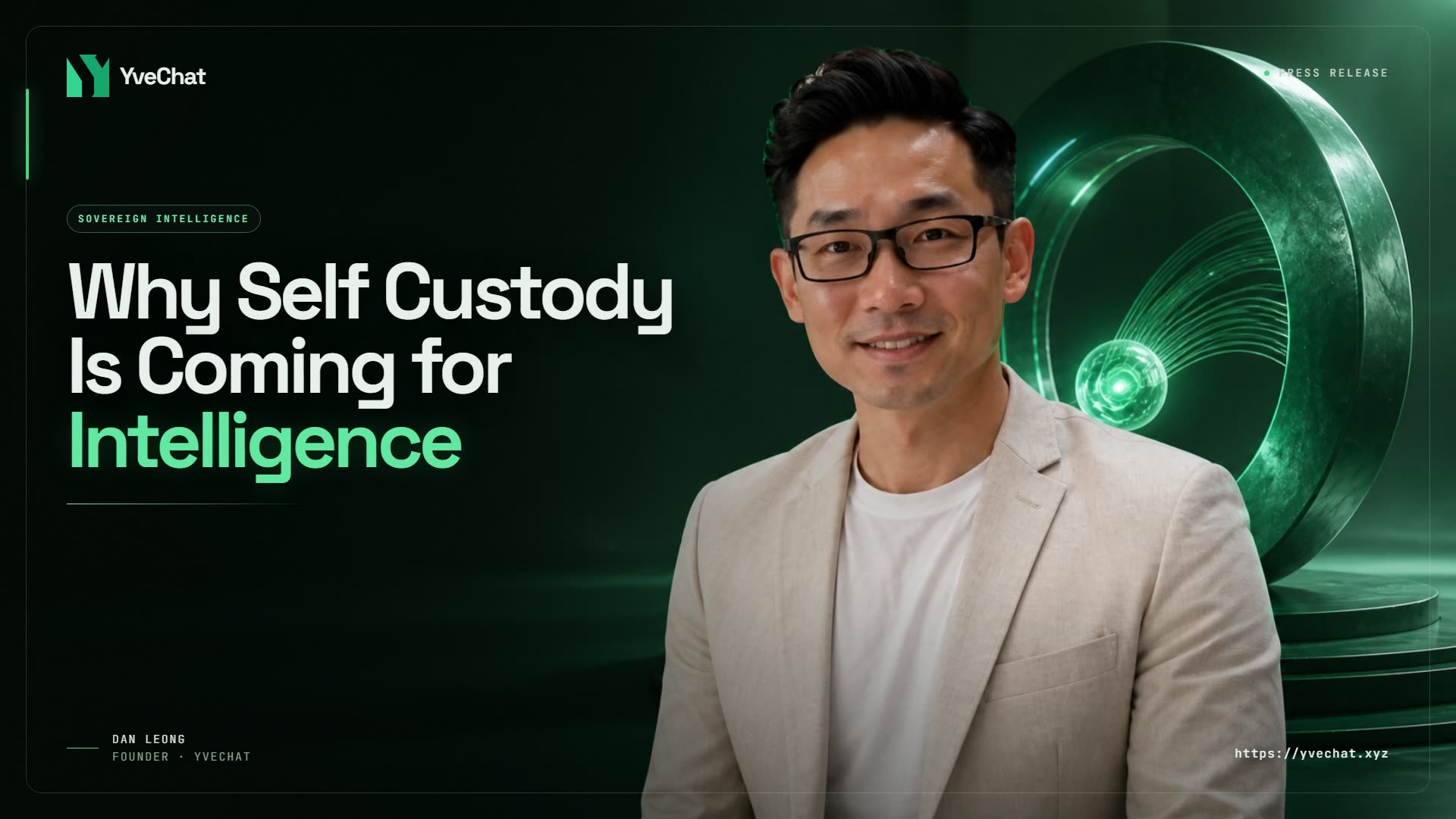
YveChat is extending one of crypto's most established principles into a new category: intelligence.
AI workspaces are becoming repositories for prompts, drafts, research, decisions, generated content, and years of accumulated context. As those records grow, custody becomes increasingly important. For YveChat, this is the founding thesis behind the Sovereign AI Workspace.
"Crypto taught an entire generation that custody changes the meaning of ownership," said Dan Leong, Founder of YveChat. "We believe the same principle will become important for intelligence. The record of how you think should belong to you."
From financial keys to intelligence
Self custody gave individuals direct control over digital assets through keys they hold themselves. YveChat applies that principle to the growing body of information created through AI.
A single conversation may reveal little. Months of conversations can reveal considerably more. An AI workspace can accumulate:
- Private research and working documents
- Drafts and unfinished ideas
- Business and technical decisions
- Personal writing patterns and preferences
- Project context and relationships
- Questions, uncertainties, and reasoning processes
- Generated images and other creative outputs
Together, these interactions can form a detailed record of how someone works and thinks. That record is becoming an asset in its own right.
"The more useful AI becomes, the more valuable the accumulated context becomes," Leong said. "Eventually, changing an AI provider should feel like changing a model inside your workspace. Your history and your infrastructure should remain under your control."
Sovereignty built into the architecture
YveChat translates this philosophy into four layers of user-held control: compute, data, access, and identity.
The YveChat Workspace provides the browser interface for conversations, model selection, tools, and citations. YveChat Engine runs on the user's computer and handles runtime discovery, routing, secrets, tool execution, and conversation persistence.
For local inference, the Engine can connect directly to Ollama models running on the same hardware. Conversations are persisted through the Engine to a SQLite database on the user's disk. The local flow is straightforward:
Workspace → YveChat Engine → Local Model → YveChat Engine → Workspace → Local Storage
When a local model is used, the user's machine performs the inference. No hosted model credential is required for that conversation. The Workspace and Engine are connected through a six-digit pairing code approved by the user on their own machine. Pairing includes origin binding, hashed storage, expiry, and revocation.
"Every architectural decision comes back to one question," Leong said. "Who holds the important thing?"
Model choice stays with the user
YveChat's sovereignty thesis also shapes how models are treated.
The Engine is designed around provider normalization, allowing different runtimes to operate as peers within the workspace. Ollama-served local models are available today. OpenAI-compatible endpoints are experimental, including vLLM through the compatible adapter. Full hosted provider credential management is planned.
The direction is toward a workspace where users can select intelligence according to the task while keeping their working environment and accumulated context centered on infrastructure they control.
This principle also informs YveChat's permanent commitment to zero inference margin. Users running models locally provide their own compute. Users accessing hosted providers maintain the provider relationship directly. YveChat's revenue model focuses on software, gateway services, deployment support, marketplace activity, and future network participation.
"Provider neutrality becomes much stronger when there is no economic incentive to push a user toward a particular model," Leong said. "The model should be chosen because it is right for the task."
Control extends to tools
The same custody principle becomes increasingly important as AI systems gain the ability to act.
YveChat's tool architecture is designed around visible activity and explicit boundaries. Reading and retrieval operations disclose their activity. Actions that write, send, purchase, or authenticate are designed to require explicit confirmation.
External services create visible boundaries as well. Local inference can remain on the user's machine. A web search requires communication with an external search service. YveChat treats that as a deliberate exit from the local boundary and surfaces the activity accordingly.
As MCP connections and more advanced agent tooling arrive, permission becomes another form of custody.
"Control over your conversations is one layer," Leong said. "Control over what an AI is authorized to do on your behalf is the next."
Ownership comes with responsibility
Self custody transfers operational responsibility alongside control.
Users running their own infrastructure assume greater responsibility for hardware, security, backups, availability, and maintenance. Organizations processing data for others may also assume regulatory obligations associated with operating that infrastructure. YveChat documents these constraints as part of its broader approach to verifiable sovereignty.
Local models also carry practical limitations. Model capability, context length, memory requirements, parallelism, GPU compatibility, and driver support can all affect the experience.
More infrastructure in the user's hands means more decisions in the user's hands. That responsibility is part of ownership.
Intelligence is becoming something we hold
AI began as something people accessed. It is increasingly becoming somewhere people work, think, create, research, and make decisions. That shift changes the importance of custody.
The longer an AI workspace exists, the more context it can accumulate. As agents become more capable, the authority entrusted to them can grow. As these systems become more personal, control over their infrastructure becomes more consequential.
Crypto established a simple principle for digital ownership: control follows the keys. YveChat is carrying that principle forward into intelligence.
"The destination is a workspace where your models can change, your tools can evolve, and your infrastructure can grow while the fundamental relationship stays the same," Leong said. "You hold it."
Your models. Your machine. Your workspace.